Talk
Messages, channels, and calls
Direct messages, channels, voice rooms, and group calls.
 Pigeon Swarm Public alpha
 Communication without a platform owner
Messages, channels, calls, and files in one application. The network replicates application data, so one server going offline does not take the network with it.
A self-hosted alternative to Discord for private groups that want a familiar chat app without a central account.
Public alpha Most features work. Expect instability and frequent changes while the platform evolves.
The app includes
The application
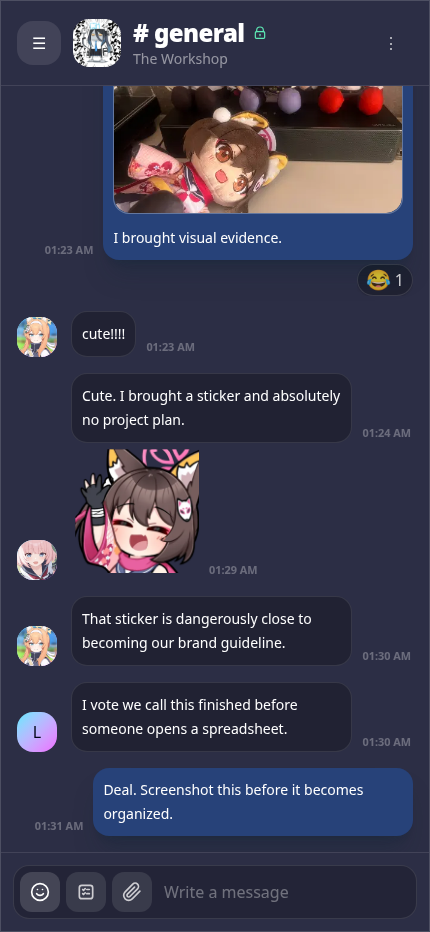
Desktop and mobile clients keep conversations, calls, media, and network management in one place.
Talk
Direct messages, channels, voice rooms, and group calls.
Share
Files, images, video, stickers, and replies inside the conversation.
Organise
Your identity, contacts, networks, and shared spaces on desktop or mobile.
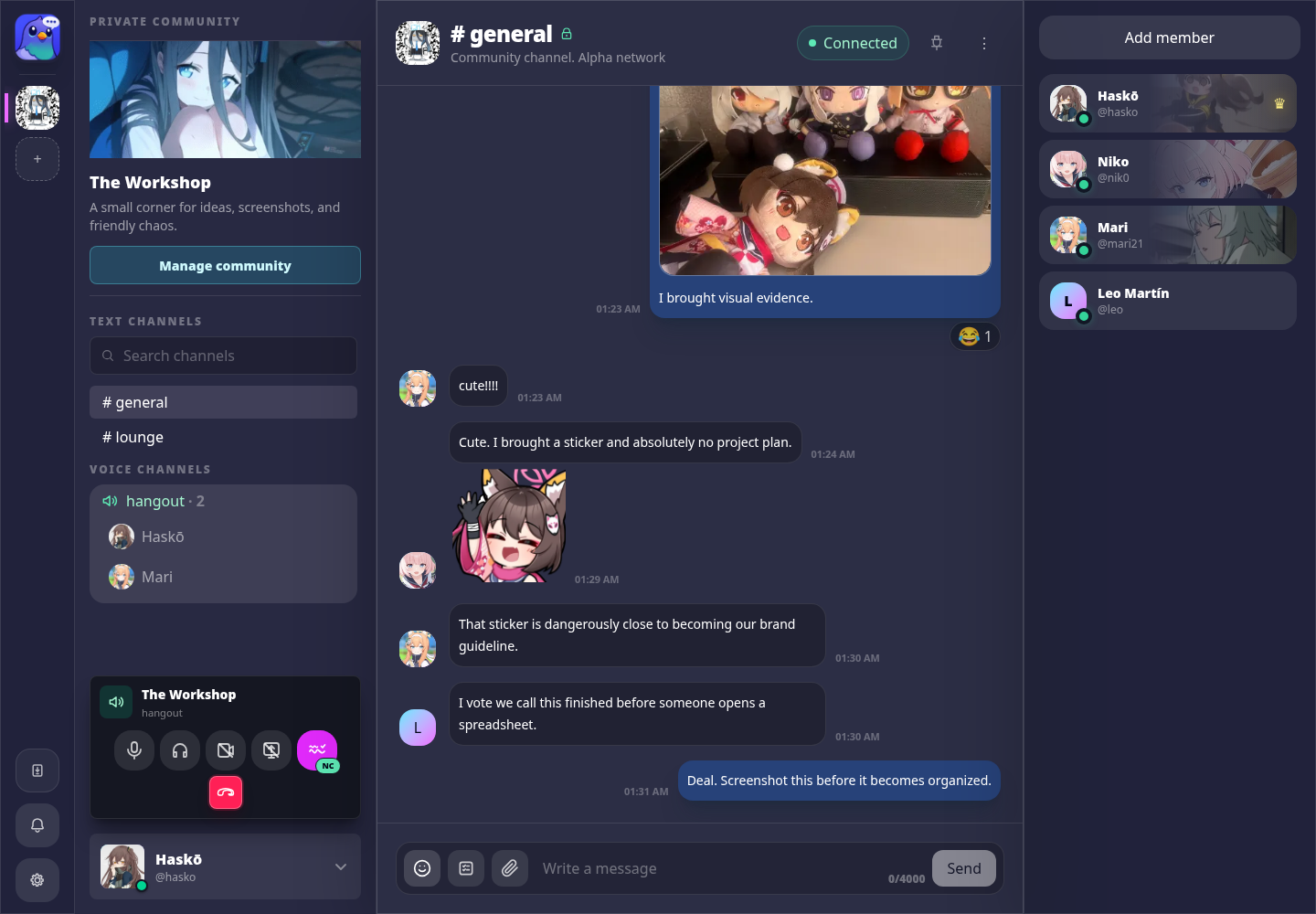
Desktop interface
Networks, channels, conversations, and participants remain visible on larger screens.
Peer-to-peer by design
Nodes in the same network replicate its content. Your identity belongs to you, not to the node you used last.
Last node used
Same network data
Same network data
Nodes replicate the network content between them.
If one node goes down, connect to another node in that network.
Use the same credentials and continue with the same data.
Privacy by architecture
Nodes store and replicate data. Your device keeps the credentials and encrypts private conversations before transmission.
Your private keys and password remain on your device. No phone number, government ID, or central platform account is required.
Each node keeps a copy of network data. Private message content arrives encrypted, and nodes do not receive your password or private keys.
Run an open network or require permission before other nodes connect.
Kept locally
Our position
Chat Control proposals seek to make communication services detect content inside private messages. Scanning on a server or on your device turns private correspondence into an inspection point.
Pigeon Swarm opposes Chat Control, identity gates, message scanning, and backdoors. The internet should remain open and permissionless; the user decides how to use the software.
Public source
The client, node, and deployment wrapper are public. Anyone can inspect how identities, encryption, and replication work, report a problem, or propose a change.
Desktop and mobile interface
02 / Node pigeon-swarm-nodeNetwork and application services
03 / Distribution pigeon-swarmRunnable application image
This is not the MIT license and it does not grant unrestricted commercial use. Commercial use requires a separate license from the author.
Read the license ↗Operate your own node
The repository packages the frontend, backend, and persistent storage into one Docker image, with relay configuration for private-network nodes.
$ git clone https://github.com/haskou/pigeon-swarm.git
$ cd pigeon-swarm
# Create .env with a private TURN secret; see the deployment guide.
$ docker compose up -d